

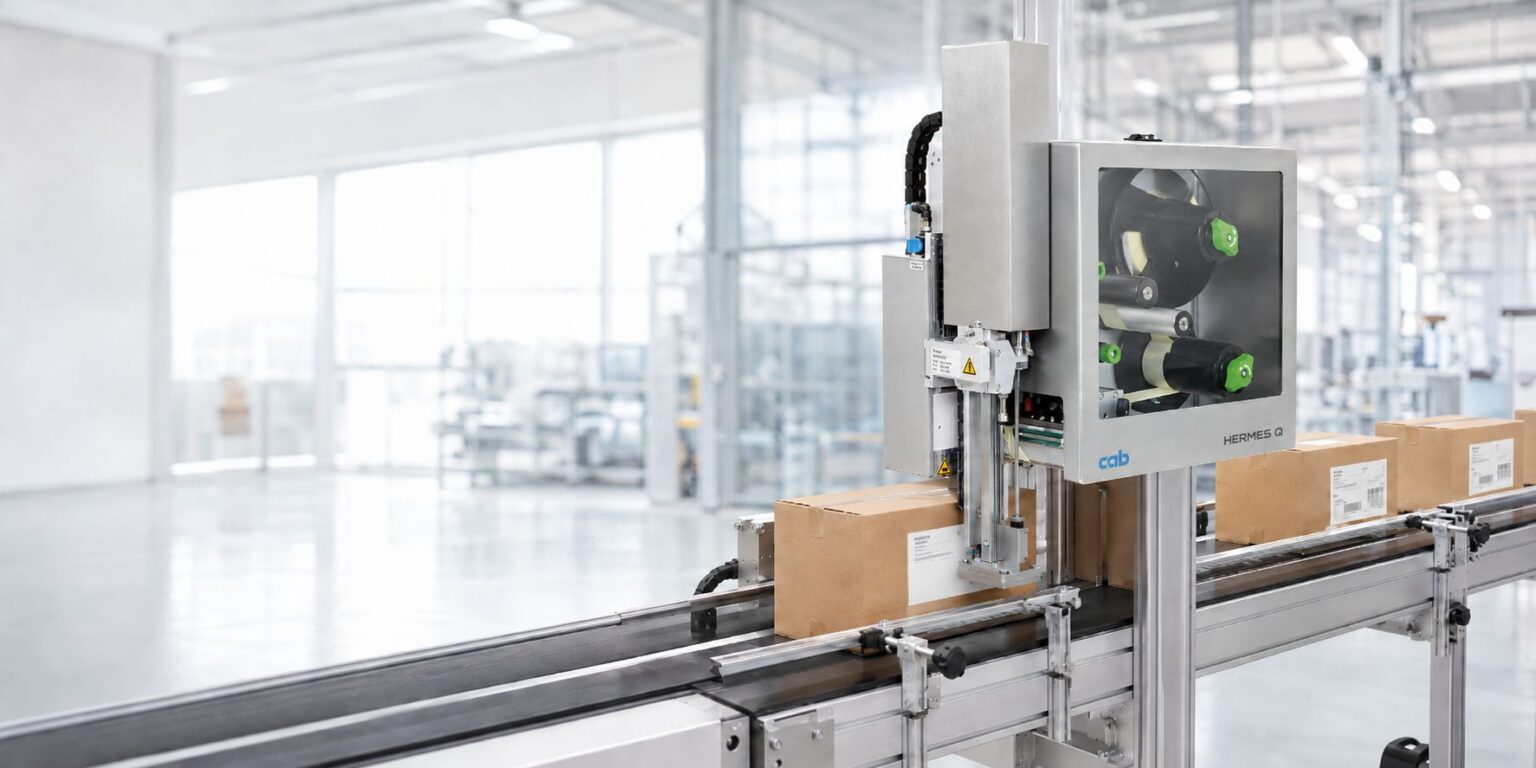
CAB HERMES Q are industrial Print & Apply systems designed for the automatic printing and application of labels directly within the production process. They combine a label printer, a material handling system, and a specially selected applicator in a single unit. The label can be printed with up-to-date data and immediately applied to a product, package, or component— without manually transferring it between the printer and the application station.
01/
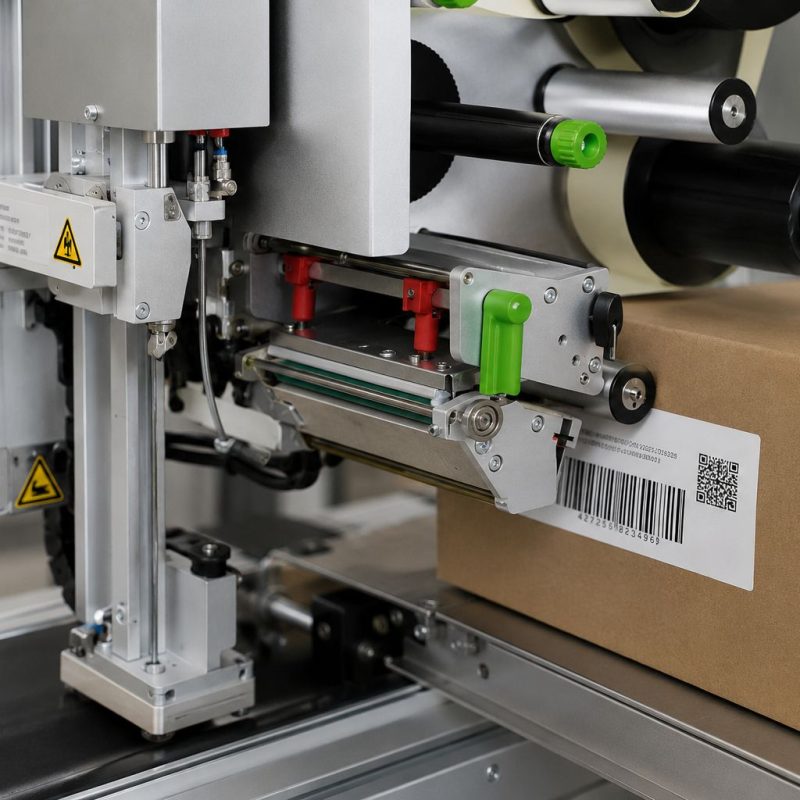
In the traditional process, a label may first be printed and then manually transferred and affixed to the product. CAB HERMES Q integrates both stages.
The system prepares the label, prints the required information, and then sends it to the applicator, which automatically applies it to the correct location. Data can therefore be generated immediately before application, without the need to prepare pre-printed batches of labels.
The label can include, among other things, serial numbers and lot numbers, dates, production and logistics data, barcodes, 2D codes, and other variable information transmitted from the host system.
The HERMES Q family includes several device models and a wide selection of applicators. This allows the system to be adapted to both small labels and limited installation space, as well as to wide logistics labels, products of varying heights, or applications performed on moving parts.
In the appropriate configurations, the system can prepare the next label while the current one is being applied. This allows the HERMES Q to be used in automated lines with a continuous product flow.
This solution is used, among other things, in manufacturing, logistics, packaging, the automotive industry, and processes requiring the automatic application of labels with variable data.
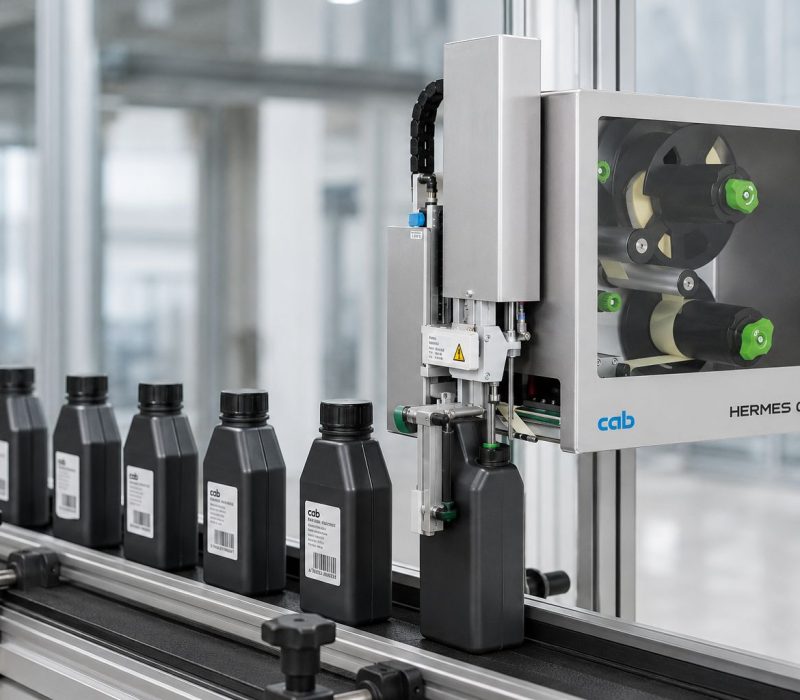
One of the most important advantages of HERMES Q is the ability to choose the label application method that best suits a specific application.
Depending on the module used, labels can be applied from the top, bottom, or side to products that are stationary or moving on a conveyor. Labels can be applied to flat, cylindrical, curved, and sloped surfaces, as well as to products of varying heights.
CAB offers various types of applicators, including linear, pendulum, pneumatic blow-on, pressure-roll applicators, corner-labeling solutions, and vacuum-tape applicators.
This allows HERMES Q to be used, among other things, for:
The system can dispense labels to the left or right and can be installed in various orientations. This facilitates integration with both new production lines and existing machines where installation space is limited.
03/
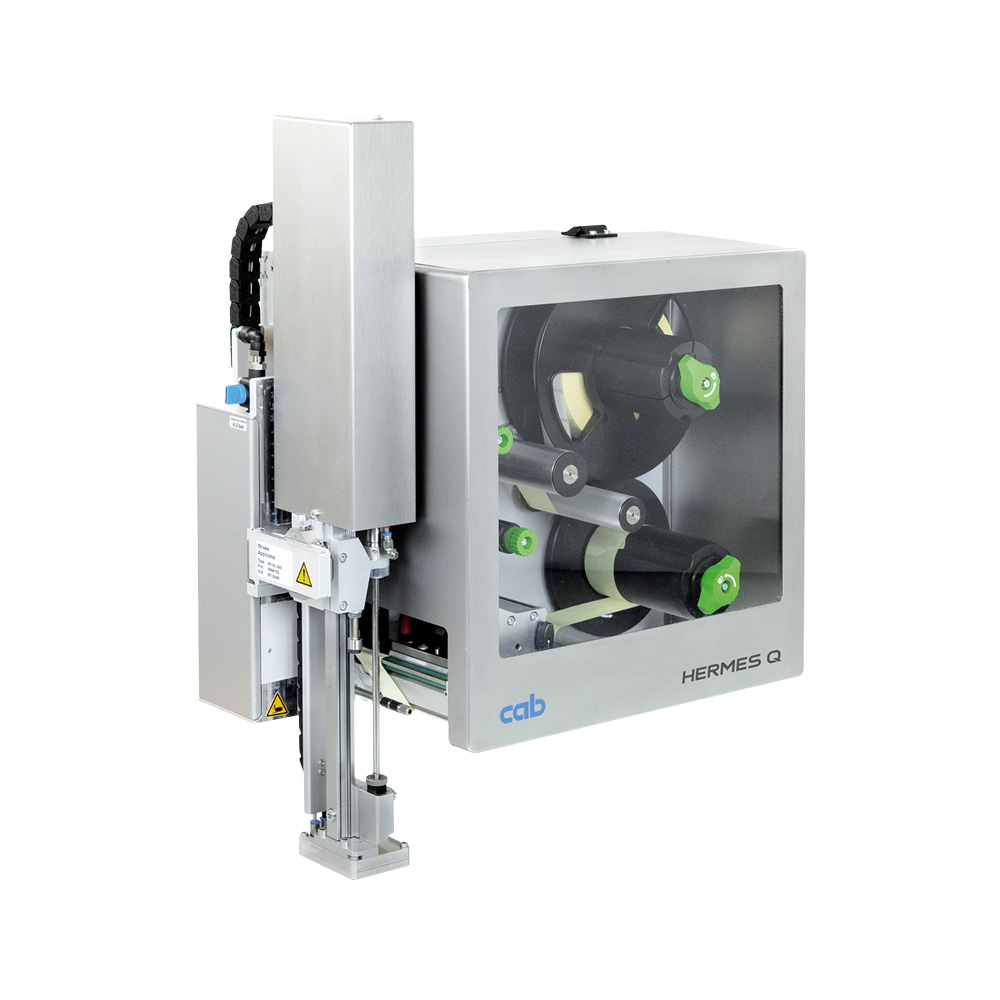
The HERMES Q family includes several models that differ primarily in maximum label width, resolution, and print speed.
Model | Resolution | Max. print speed | Max. print width | Max. label width |
CAB HERMES Q2 | 300 / 600 dpi | 300 / 150 mm/s | 56.9 / 54.1 mm | 58 mm |
CAB HERMES Q4.3 | 200 / 300 dpi | 300 mm/s | 104 / 108.4 mm | 114 mm |
CAB HERMES Q4 | 300 / 600 dpi | 300 / 150 mm/s | 105.7 mm | 114 mm |
CAB HERMES Q6.3 | 200 / 300 dpi | 250 mm/s | 168 / 162.6 mm | 174 mm |
The widest model in the family, capable of handling labels up to 174 mm. It is designed, among other things, for large logistics labels, such as Odette, UCC, and GS1 labels.
Models designed for a wide range of standard manufacturing and logistics applications. They support labels up to 114 mm wide and offer various resolution options, allowing you to tailor the device to your required throughput and print quality.
The most compact model in the family. It works well where small markings are used or installation space is limited. The 600 dpi version allows for the production of very fine text, graphics, and codes.
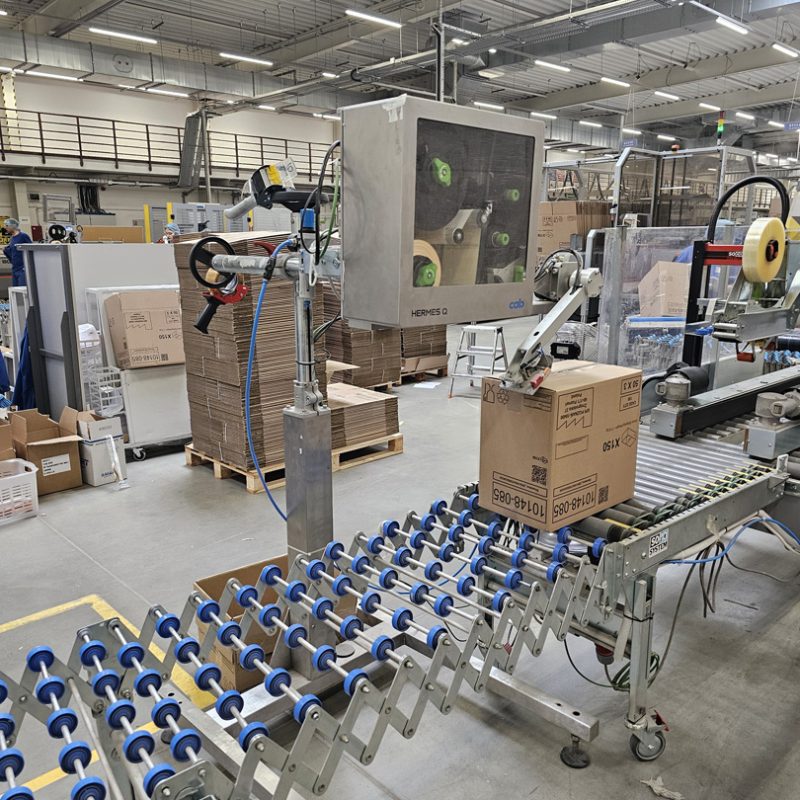
Combining printing with automatic application eliminates the need for a separate step of manually applying labels and improves the consistency of the entire labeling process.
The system’s key benefits include:
The device’s rigid construction and precise material handling ensure consistent print positioning and stable execution of successive printing and application cycles.
The HERMES Q can handle a variety of label materials, including paper and select synthetic materials. For small labels, non-standard substrates, or labels requiring special adhesives, it is recommended to conduct a real-world application test before implementation.
05/
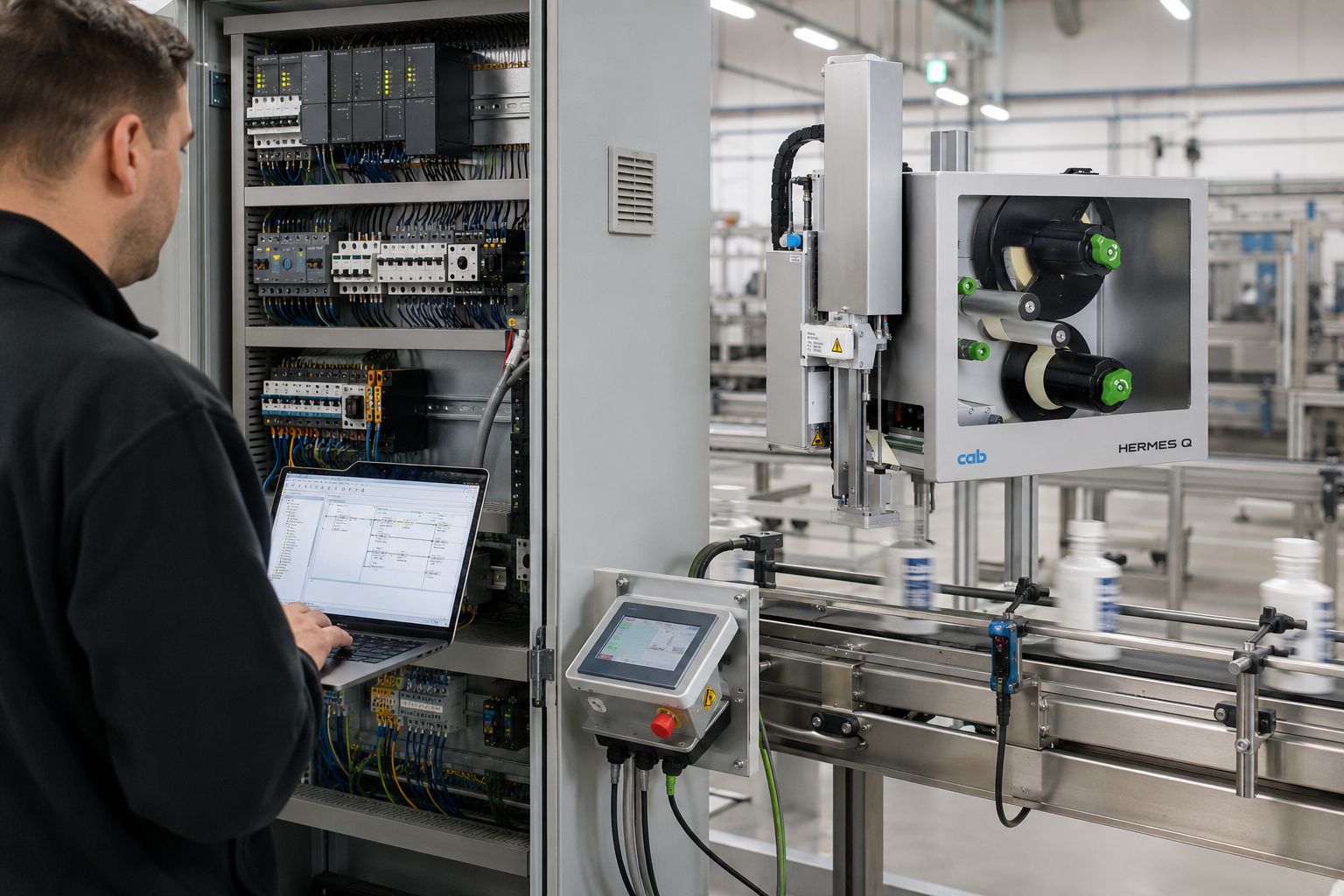
The CAB HERMES Q is designed to operate as part of an automated workstation or a complete production line consisting of other automation devices. The devices are equipped with, among other things, Ethernet, USB, RS232C, and a digital I/O interface, which enables communication with a PLC and the machine’s automation system.
The system can receive signals regarding the start of printing or application, the feeding of the next label, the stoppage of the process, or a reprint. At the same time, it can send information to the control system regarding the device’s readiness, the label’s position, the end of the material, and any errors that occur.
Data for printing can come from production systems, logistics systems, or other host applications. HERMES Q also integrates with label design and management software, including CAB solutions and popular systems used in industrial environments.
The color touchscreen allows for local configuration of parameters, task management, and diagnostics. If the device is installed in a hard-to-reach location, an external operator panel can be used.
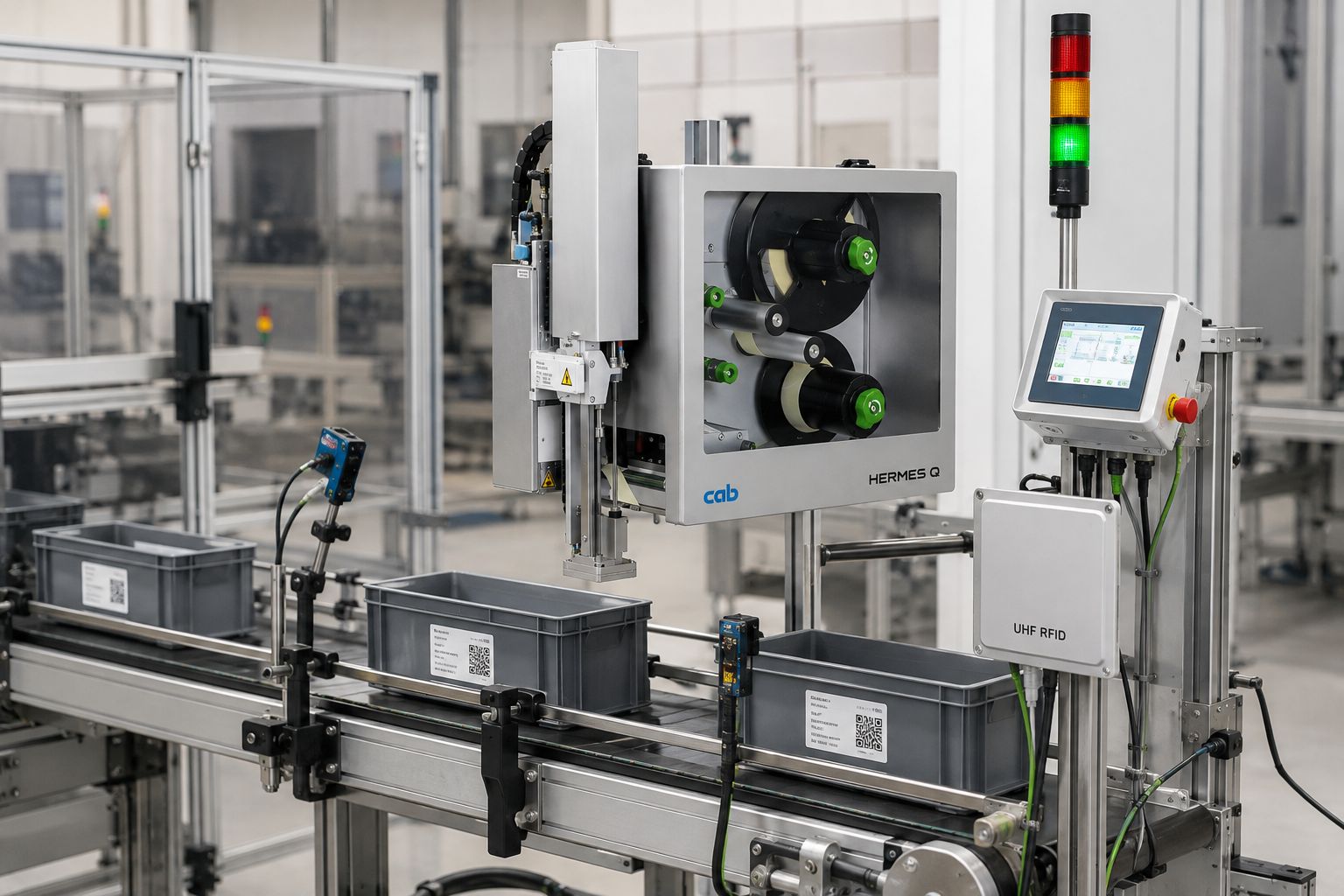
Select HERMES Q models can be equipped with a UHF RFID module, which allows label printing to be combined with reading or writing data to an RFID tag.
This makes it possible to create both a visual product label and an electronic identifier in a single process. The solution can be used, among other things, in traceability, manufacturing, and logistics processes that require the automatic identification of objects.
The system can also be expanded to include components needed to create a complete labeling station, such as product sensors, unwinders for larger rolls, signal lights, an external operator panel, scanners, mounting hardware, and compressed air preparation systems.
The selection of equipment depends primarily on the type of applicator, the line design, and the process control method.
07/
With a Print & Apply system, choosing the printer model is just one part of the configuration. It is equally important to determine how and where the label will be applied to the product.
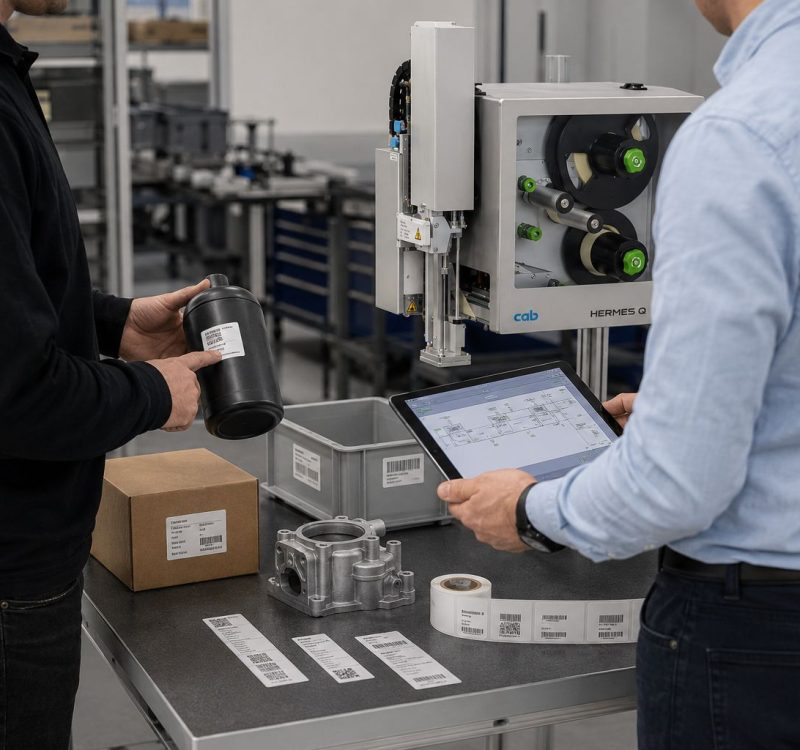
When selecting a solution, we primarily analyze:
Based on this, you can select the appropriate HERMES Q model, applicator, installation method, sensors, and communication with the production line.
In the case of cylindrical or irregular surfaces, products of varying heights, very small labels, or high-speed dynamic labeling, it is particularly important to verify the entire process in advance, rather than just the printer’s parameters.
Do you need a system that automatically prints a label with the current information and applies it directly to the product or packaging?
Contact an HKK Group consultant. We’ll help you select the right CAB HERMES Q model, applicator, installation method, sensors, and communication with the production line’s automation system.
We can develop solutions for labeling both stationary products and those moving on a conveyor, as well as for demanding applications on flat, cylindrical, and irregular surfaces.