

Automatic label applicators allow labels to be applied to products, packaging, and components without manual application. Depending on the process, they can function as labeling heads that apply pre-printed labels or as complete Print & Apply systems that print the label and immediately apply it to the product. CAB solutions can be tailored to the product type, label format, line speed, application location, and method of integration with automation systems.
01/
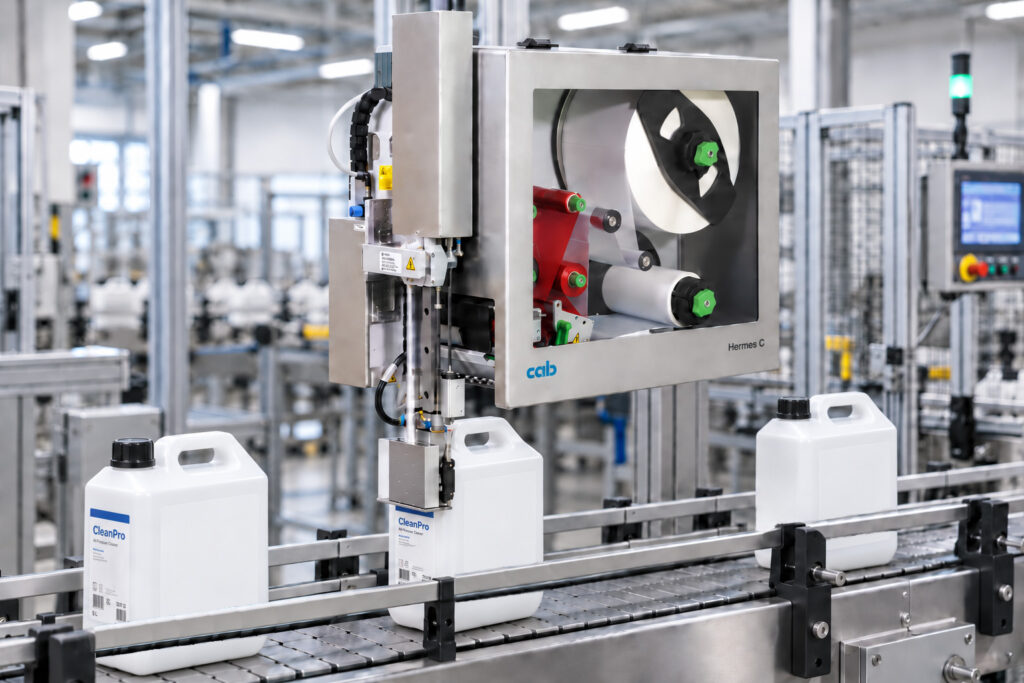
Not every production line requires the same labeling method. In one process, it is sufficient to automatically apply pre-printed labels, while in another, it is necessary to print the current data immediately before applying the labels. Therefore, the CAB solutions offered by our company can be divided into two basic groups.
Print & Apply systems combine a printer and an applicator. The label is prepared with up-to-date data and then automatically applied to the product. This solution is suitable, among other things, for applications where lot numbers, serial numbers, logistics data, codes, or information that changes with each product are printed.
Automatic labeling heads pick up pre-printed labels from a roll and automatically apply them to the product. They can operate at high speeds and be customized to fit the design of a specific machine or production line.
The product line also includes hybrid and modular solutions—print heads can be expanded with print modules, and SQUIX printers can be equipped with compatible applicators.


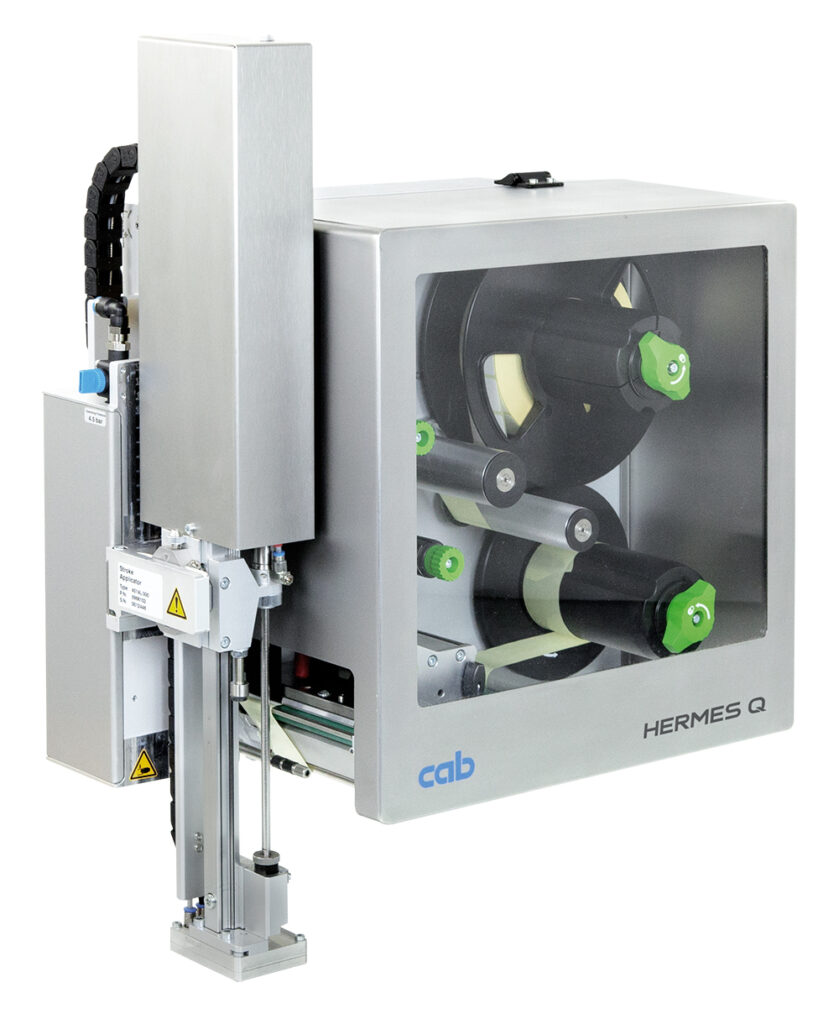
CAB HERMES Q is a versatile family of industrial Print & Apply systems. The label is printed with the current data and automatically applied to the product, packaging, or component.
A wide selection of models and applicators allows for the handling of small and large label formats, products in motion or at rest, and application from above, from the side, or from below. The system can also handle cylindrical and irregular surfaces.
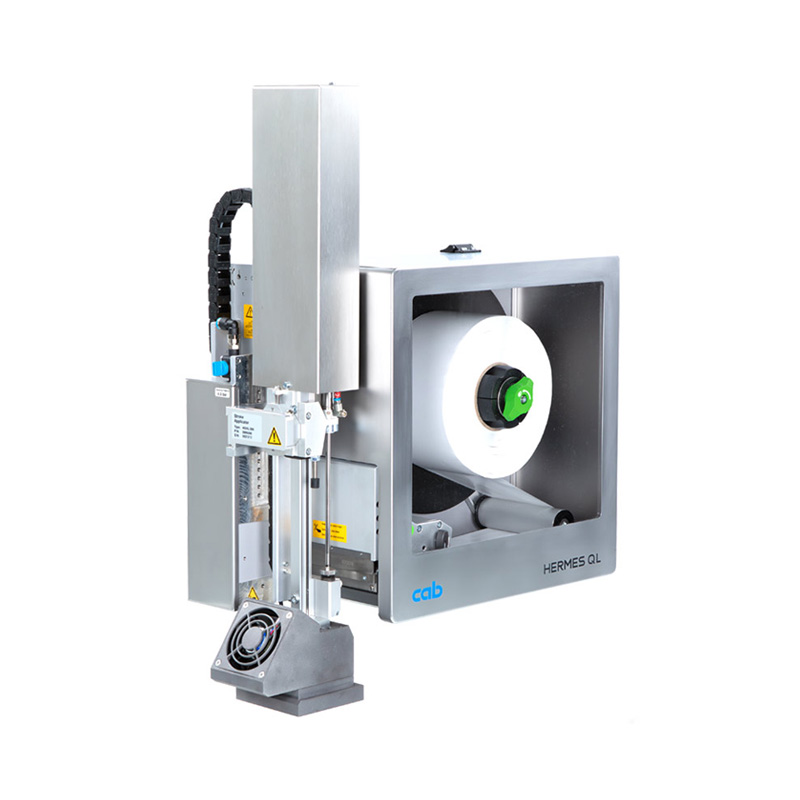
The CAB HERMES QL is designed for the automatic printing and application of labels made from linerless and InNo-Liner materials.
The absence of a traditional silicone backing helps reduce waste, increase the length of material on a single roll, and decrease the frequency with which the roll needs to be replaced. The continuous material can also be automatically cut to the required label length.
This solution is particularly useful in logistics, shipping, and manufacturing processes that involve large numbers of labels.
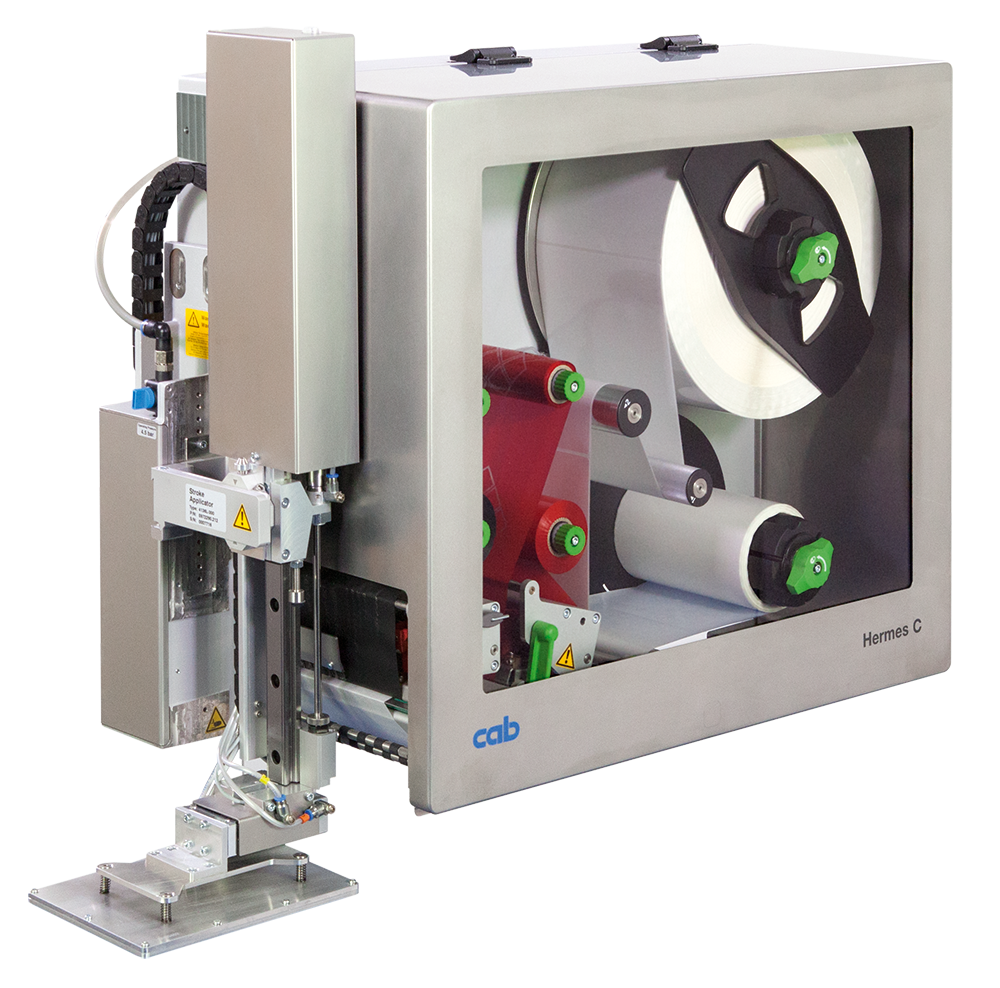
The CAB Hermes C combines two-color label printing with automatic label application. Two thermal transfer print heads enable the completion of the entire labeling process in a single step.
This solution is particularly useful for labeling chemicals in accordance with the GHS, where a single label may include, among other elements, black symbols and text, as well as red frames around warning pictograms.
Printing variable data allows you to prepare the correct label immediately before applying it to the packaging.
03/
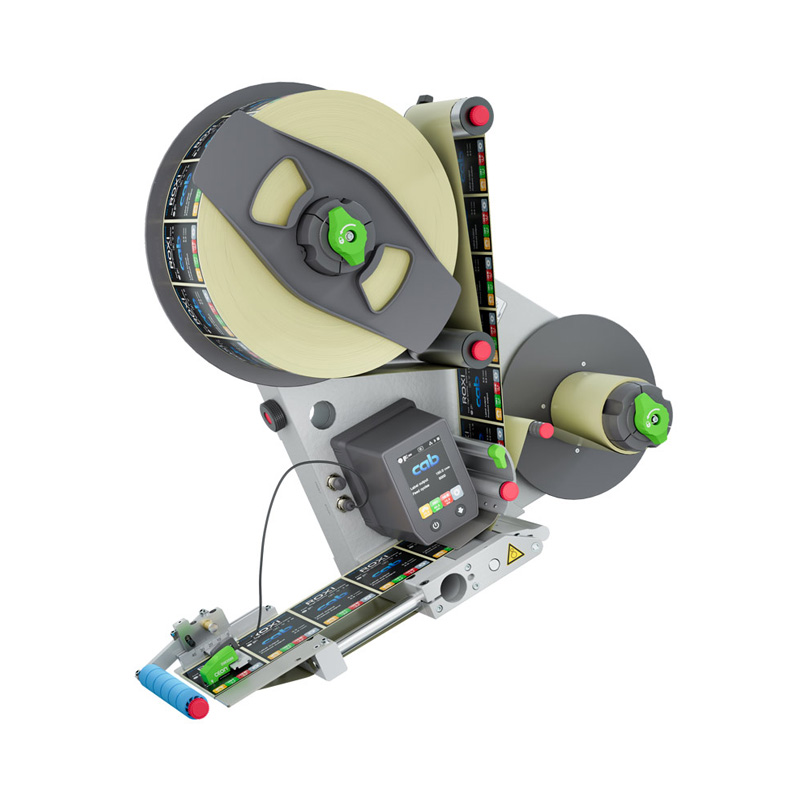
The CAB ROXI is a compact industrial applicator designed for the automatic application of pre-printed labels directly during the production process.
It can operate at speeds of up to 30 m/min, be mounted in various orientations, and work with rollers, brushes, and additional application modules.
ROXI can be used for more than just labeling. When properly configured, the device can also apply protective films, membranes, gaskets, thermal pads, and other self-adhesive components.
In more complex configurations, the print head can work in conjunction with an additional applicator or print module.
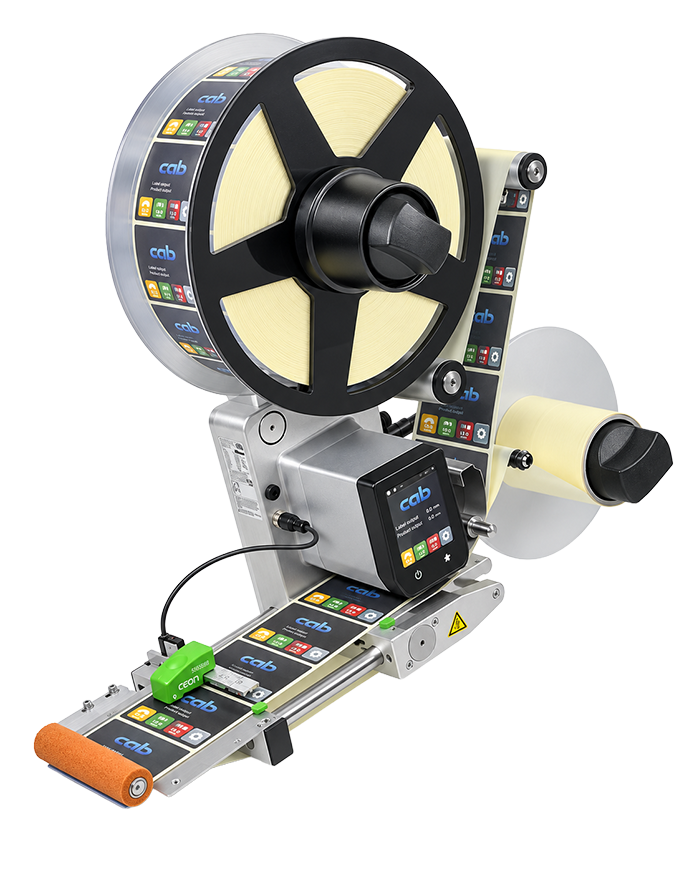
The CAB IXOR+ was developed for more demanding and high-performance industrial processes.
The modular design allows you to select unwinding and rewinding units to match the required throughput. Depending on the configuration , the material speed can be up to 50, 75, or 120 m/min, and in custom solutions, up to 200 m/min.
The IXOR+ can be synchronized with the speed of the product being conveyed, integrated with PLCs and higher-level systems, and expanded with a printing module to perform the Print & Apply process.
04/
Not every application requires a dedicated Print & Apply system right away.
CAB SQUIX industrial printers can be used with compatible applicators, allowing a standard printing station to be expanded to include automatic label application.
This solution combines the capabilities of an industrial printer with an application for products that are stationary or in motion. The available configurations allow labels to be applied to various surfaces and tailor the application method to a specific workstation.
SQUIX with an applicator may be an interesting option for companies that want to automate their labeling process in stages, without immediately switching to the dedicated HERMES system.
| Requirement | Recommended solution |
|---|---|
| Variable Data Printing and Automatic Label Application | CAB HERMES Q |
| Print & Apply without a traditional label backing | CAB HERMES QL |
| Two-Color Print & Apply, including for GHS labeling | CAB Hermes C |
| Compact automatic applicator for pre-printed labels | CAB ROXI |
| Fast and Demanding Automatic Labeling Processes | CAB IXOR+ |
| Upgrade of an industrial printer with automatic label application | CAB SQUIX + applicator |
When making the final selection, factors to consider include, among others, the type of product, the label’s format and material, the application location, the surface geometry, the line speed, the product’s transport method, the available installation space, and the requirements for communication with the automation system.
For more demanding processes, other factors may also be important, such as the method of synchronization with the conveyor, the required application module, the type of sensors, or the need for RFID.

Automatic labeling is used wherever markings need to be applied quickly, consistently, and in a specific location without manual intervention by an operator.
Typical applications include:
Labels can be applied from the top, side, or bottom to products that are in motion or that are paused during the application process.
06/
The device’s operation can be synchronized with the conveyor and the automation system for the entire line.
What are the benefits of label automation?
Depending on the process, it can provide:
With linerless solutions, an additional benefit may be a reduction in liner waste and the number of material changes.
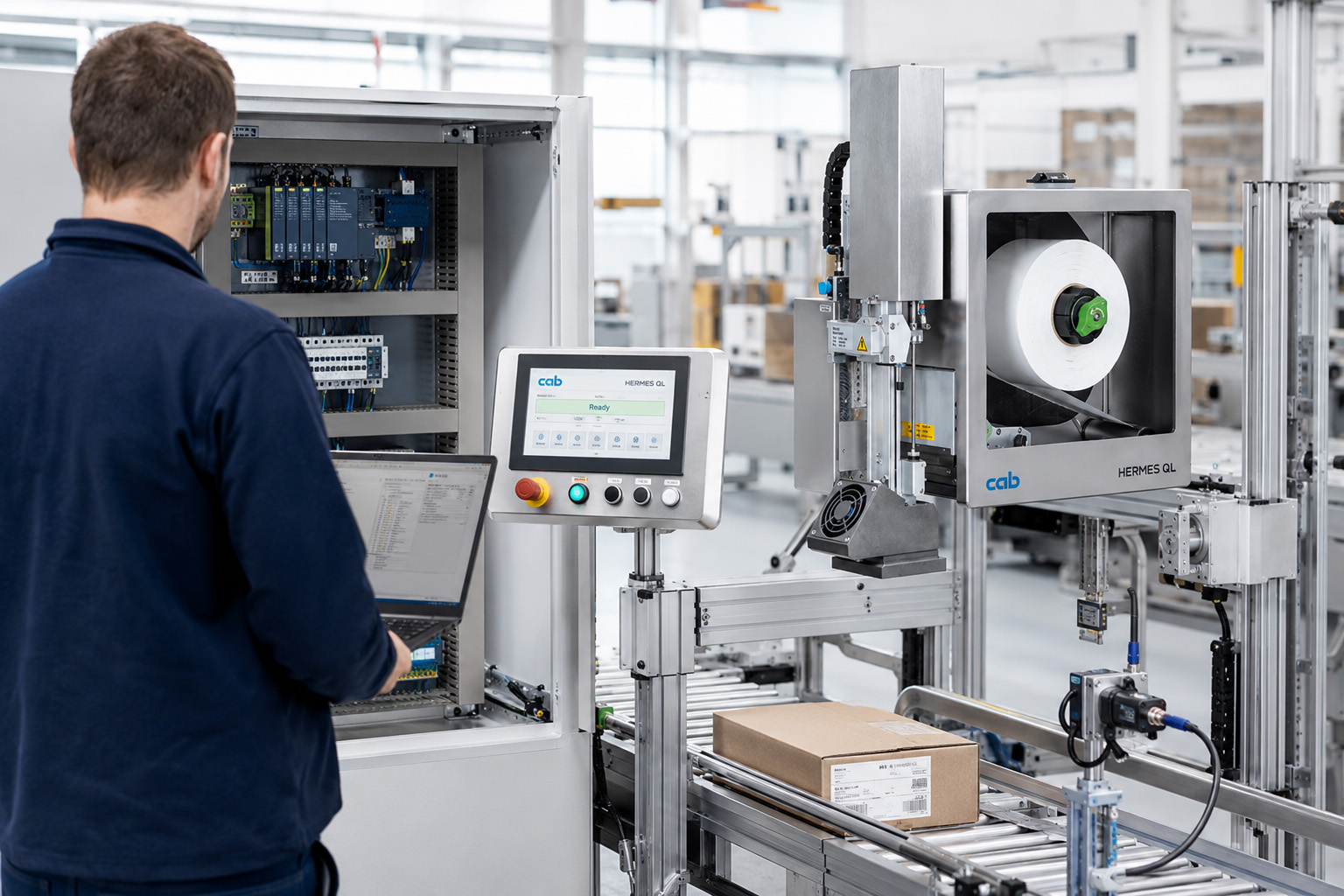
A Print & Apply system can be more than just a standalone label applicator. In an automated process, it can serve as one of the components in the flow of information between the WMS, warehouse automation, courier systems, and devices that identify and monitor shipments.
One example is labeling after order fulfillment. The WMS system can transmit data related to a specific order, and the integrated Print & Apply solution will automatically generate the correct shipping label and apply it to the box or other packaging.
If the WMS is integrated with the carrier’s system, the entire process can take place without the operator having to manually select and print the label.
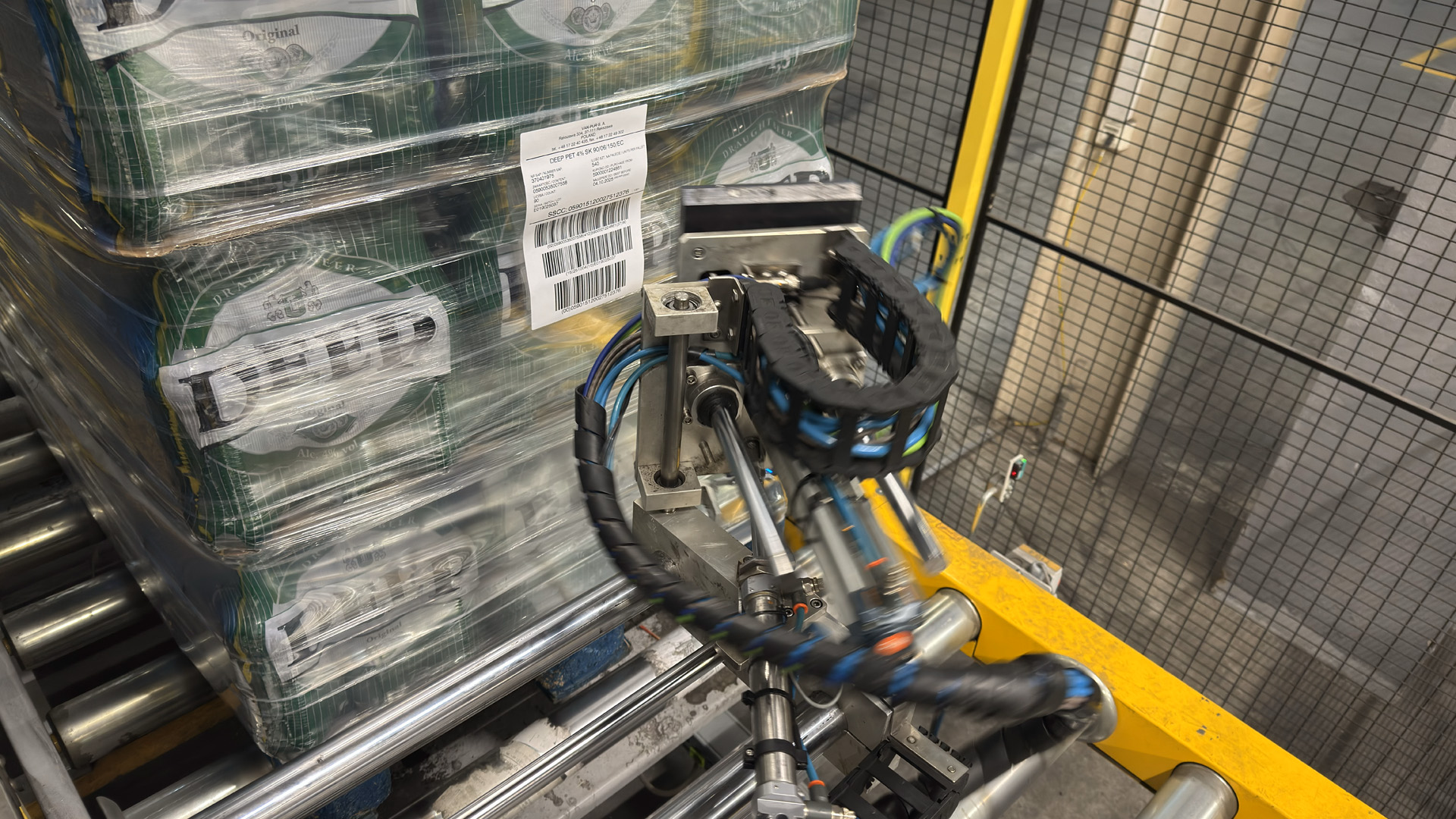
A similar model can be used for pallet shipments. The label can be automatically applied to the front, side, or several surfaces of the pallet—depending on how the process is organized and the recipient’s requirements.
Automatic labeling can also be integrated with machine vision systems, stationary code scanners , sensors, and devices that monitor shipment parameters . Before labeling, the system can verify, for example, the presence of the product, the correctness of the code, or the compliance of the shipment with the system data. Only after a positive check does it initiate printing and application of the appropriate label.
As a result, Print & Apply becomes part of a broader automation process—from data in the system, through product identification, to preparing the shipment for further transport.
08/

The automatic applicator is just one component of the entire process. A properly designed workstation should also take into account the product, the label, the application method, sensors, the mounting structure, and communication with the production line.
HKK Group helps select and integrate the CAB unit, applicator, sensors, assembly system, consumables, and communication with a PLC or master system. We also offer label design software and supply the raw material— self-adhesive labels.
For custom products and materials, we can also test the solution on actual samples before implementing it in the production process.
This device or system is designed to automatically apply labels to products, packaging, or components. Depending on the solution, it can apply pre-printed labels or print them directly before application.
The labeling head picks up a pre-printed label from the roll and automatically applies it to the product. The Print & Apply system also prints the label immediately before application, allowing it to include up-to-date variable data.
Yes. Properly selected CAB solutions can apply labels to both stationary products and those moving on a conveyor belt. The configuration depends on the line speed, the product, and the application method.
Yes. CAB solutions can work with sensors, encoders, PLCs, and master systems. The integration method is tailored to the automation system of a specific machine or production line.
Yes. Print & Apply systems such as CAB HERMES Q, HERMES QL, and Hermes C are used for this purpose, as well as appropriately configured systems that utilize labeling heads and print modules.
Yes. In certain configurations—such as those with the CAB ROXI printhead—it is also possible to apply other self-adhesive components, such as protective films, membranes, gaskets, and thermally conductive pads.