

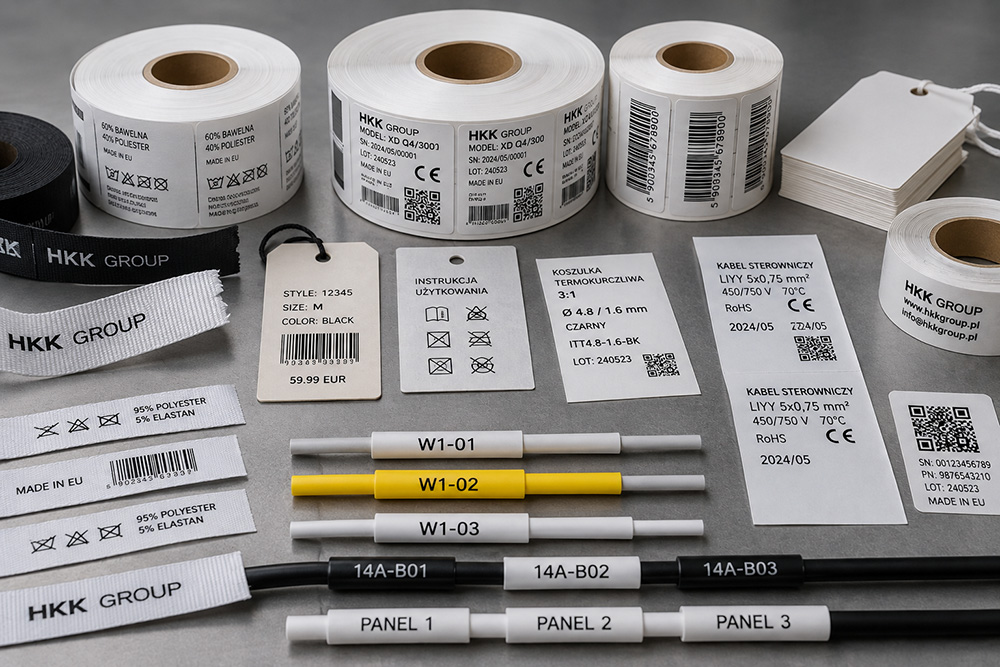
CAB XD Q industrial printers for double-sided printing allow information to be applied simultaneously to both the front and back sides of the material. This allows you to utilize the entire available surface of a label, tag, textile tape, heat-shrink sleeve, or other continuous material. This solution is used, among other things, in the production of clothing and textiles, the marking of wires and cables, the production of heat-shrink sleeves, electronics, the production of packaging and tags, and the identification of industrial products.
01/
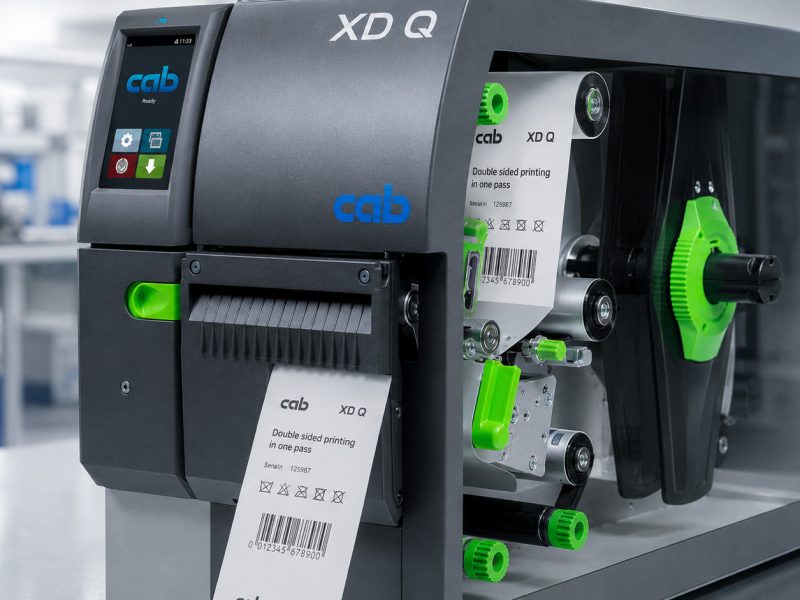
CAB XD Q label printers use two thermal transfer print heads positioned on opposite sides of the moving media. The first applies the print from the bottom, while the second prints on the top surface.
This allows both sides of the material to be printed in a single process. There is no need to manually flip the labels or run them through the printer a second time. This reduces production time and minimizes the risk of misalignment between the prints on both sides of the material.
The parameters of each print head can be adjusted independently, allowing the print temperature to be tailored to the properties of the substrate and the thermal transfer ribbons used.
The CAB XD Q can also print on only one side of the material. If only the upper print head is in use, the lower print head is automatically raised, and the feed of the thermal transfer ribbon assigned to it is stopped. This helps reduce unnecessary consumption of consumables. The device’s design also enables optimized processing of consecutive jobs without unnecessary material waste between tasks.
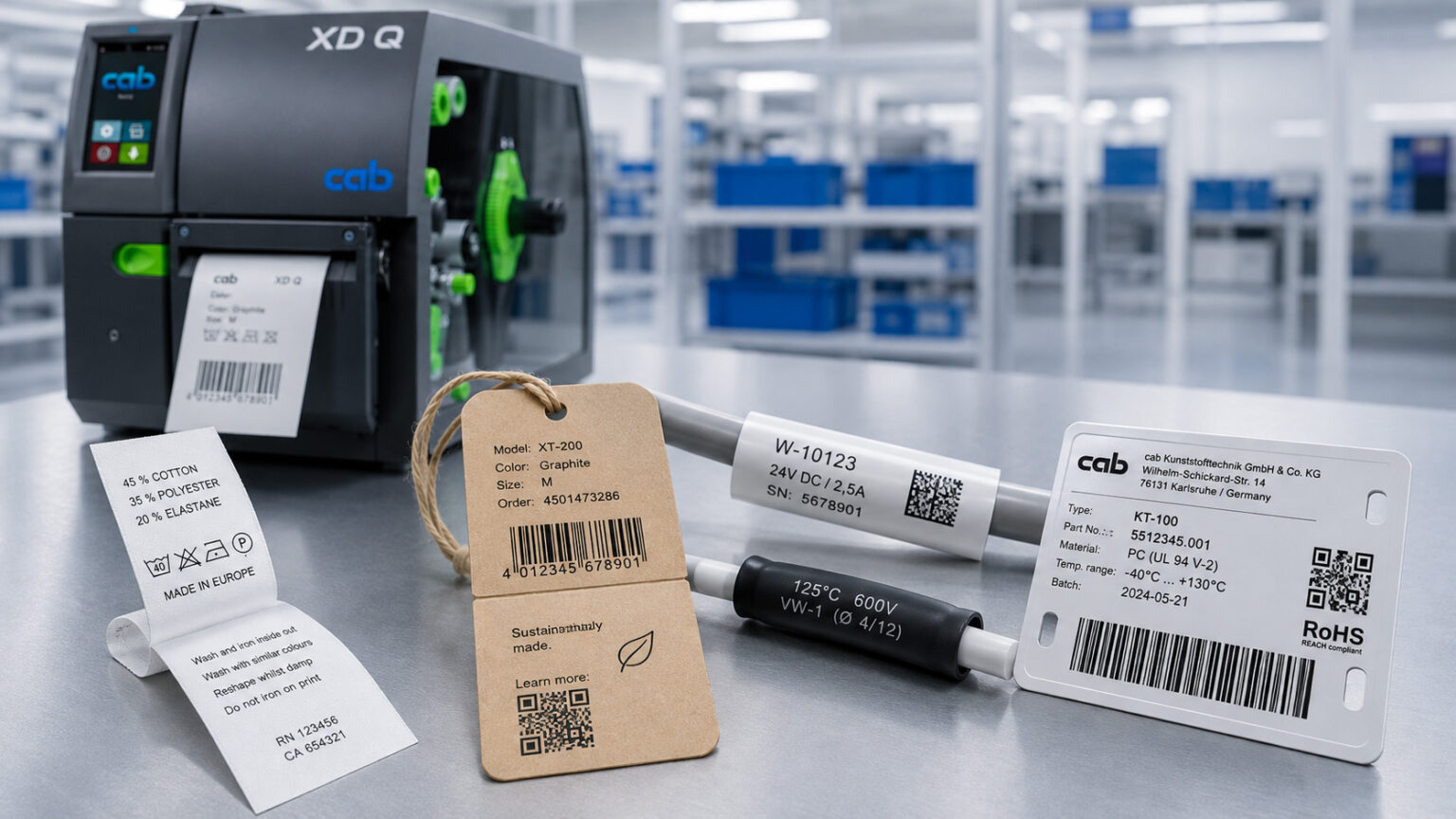
Double-sided printing allows you to increase the amount of information provided without having to make the label, tag, or tape larger. One side can contain the most important identification data, while the other can include additional information, instructions, or markings required for a specific application.
Both sides of the fabric can feature, among other things, product names and designations, instructions for use, safety information, material composition, washing and care symbols, manufacturer information, serial numbers and lot numbers, barcodes and 2D codes, cable markings, and information in various languages. The content of each side can be prepared independently and may also include variable data from a host system.
CAB XD Q printers are well-suited for a wide range of specialized applications:
Textile tapes – used to produce care labels containing information about fabric composition, size, manufacturer, and washing and care instructions.
Cardboard tags – allow you to separate marketing and identification information from instructions, product codes, prices, and additional descriptions.
Cable and wire markings – printing on both sides makes the markings easier to read even after the cable has been installed.
Heat-shrink sleeves – can be marked to identify wires, cable harnesses, and installation components.
Labels and technical materials – the devices also allow for printing on paper, cardboard, and various synthetic materials used in industry.
03/
The material is guided centrally relative to the printing mechanism. Its width is adjusted using a spindle, which facilitates the precise positioning of both standard labels and very narrow continuous media.
The built-in separator separates the printed substrate from the thermal transfer ribbon. This improves feed stability and reduces the risk of the ribbon sticking to the material. As standard, the printer is equipped with a steel feed roller designed for use with textile materials, among other things. An optional rubber roller can be used when printing on heat-shrinkable T-shirts.
The CAB XD Q can process materials wound on rolls or spools, as well as those folded accordion-style. Supported substrates include, among others, paper, cardboard, textile tapes, PET, PE, PP, PI, PVC, PU, acrylic materials, Tyvek, and heat-shrink sleeves in continuous and ready-to-use forms.
For materials that are particularly narrow, thick, stiff, or non-standard, we recommend conducting tests in advance and selecting a configuration that matches the actual substrate used in the process.
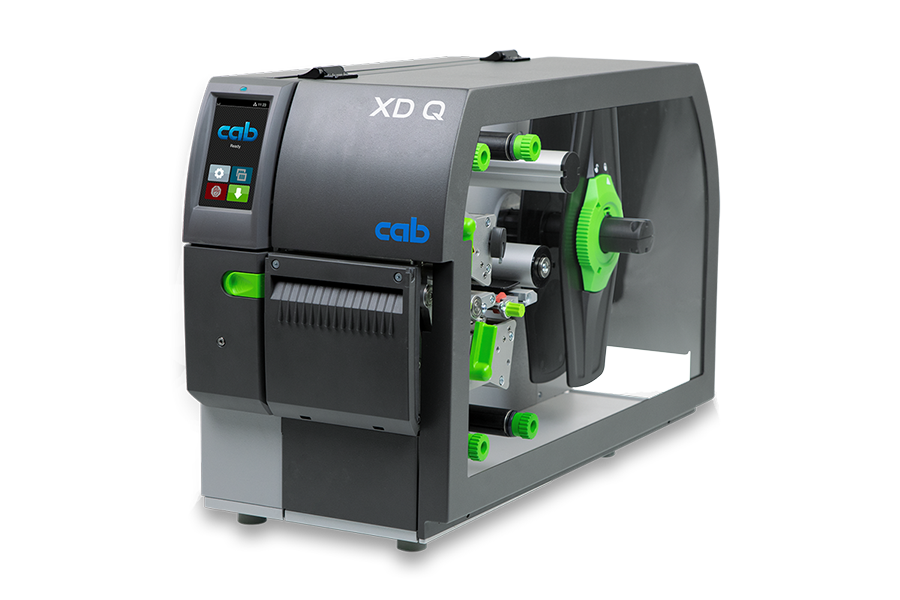
Parameter | CAB XD Q4/300 | CAB XD Q4.2/600 |
Printing Technology | thermal transfer | thermal transfer |
Number of heads | 2 | 2 |
Resolution | 300 dpi | 600 dpi |
Maximum print speed | 150 mm/s | 100 mm/s |
Maximum print width | 105.7 mm | 54.1 mm |
Maximum material width | 114 mm | 114 mm |
Maximum print length | 3,000 mm | 1,500 mm |
Label width | 10–110 mm | 10–110 mm |
Minimum label height | 20 mm | 20 mm |
Width of continuous materials | 4–114 mm | 4–114 mm |
Maximum length of the color ribbon | 450 m | 450 m |
The 600 dpi option offers a maximum print width of 54.1 mm and is primarily designed for narrow materials that require highly accurate reproduction of content. It enables the printing of small characters, fine graphics, high-density barcodes, small 2D codes, and detailed technical markings. Print heads designed for 300 and 600 dpi resolutions are not interchangeable, so the correct device model must be selected during the configuration phase.
The 300 dpi model offers a maximum print width of 105.7 mm and a speed of up to 150 mm/s. It is suitable for most industrial applications requiring double-sided marking, including wide textile tapes, cardboard tags, product labels, synthetic materials, cable markings, and heat-shrink sleeves.
05/
CAB XD Q printers can be upgraded with accessories that streamline the post-printing processing of printed material. Available options include automatic cutters, cutters with a perforating function, the ST400 M stacker with a cutter, a output tray, an external rewinder, a guide for accordion-folded media, an external control panel, and a digital I/O interface.
Cutters can be used for paper, cardboard, textiles, synthetic materials, and heat-shrink sleeves. The ST400 M stacker enables automatic cutting and sorting of finished labels, allowing the printer to become part of a more extensive production line.
The CAB XD Q is also available in a version with a UHF RFID module that enables the reading and writing of tags. The tag is read and programmed immediately before printing, and in the event of a write error, the incorrect label is marked accordingly. The RFID version is available upon request.
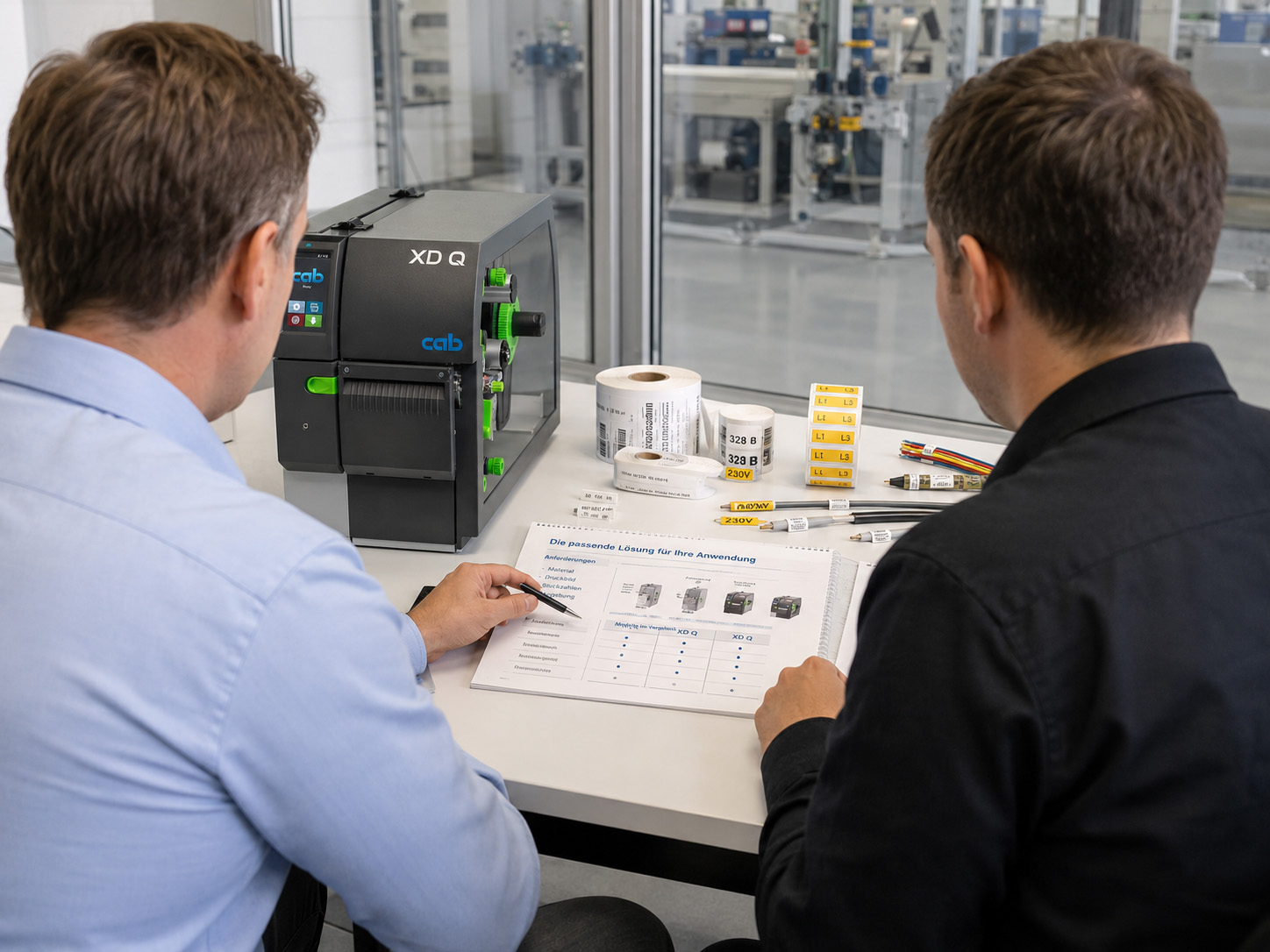
The correct configuration depends primarily on the type and width of the material, the size of the printed characters, the required resolution, the expected processing speed, and the information to be printed on each side.
When selecting a device, it is also worth considering the type of thermal transfer ribbons used, the need for automatic cutting or perforation, the method of retrieving the finished labels, integration with a host system, and the possible need to support RFID tags.
HKK Group assists with the selection of printers, consumables, and accessories. For non-standard substrates, we can also verify the feasibility of printing on samples provided by the customer.
Please feel free to contact us.