
Shortcuts
- When a standard label doesn’t provide enough space
- What are peel-off and booklet labels?
- Peel-off labels – structure and applications
- Booklet labels
- Peel-off vs. booklet—key differences
- Where are multilayer labels used?
- How to design a multilayer label?
- Peel-off and booklet labels on a roll – materials and application
- How to order peel-off and booklet labels?
- Key Information
When a standard label doesn't provide enough space
Do you need to include ingredients, usage instructions, warnings, or other information in multiple languages on the packaging, but a standard label doesn’t provide enough space? Peel-off labels and booklet inserts may be the solution. Both designs allow you to convey more information without significantly increasing the space taken up on the product, while maintaining a clean, readable appearance for the packaging.
HKK Group provides custom-made multi-layer and multi-page labels, tailored to the type of packaging, the amount of information, and the application method. We explain how peel-off labels differ from booklet labels, where they work best, and what information you should prepare before submitting a request for a quote.
What are peel-off and booklet labels?
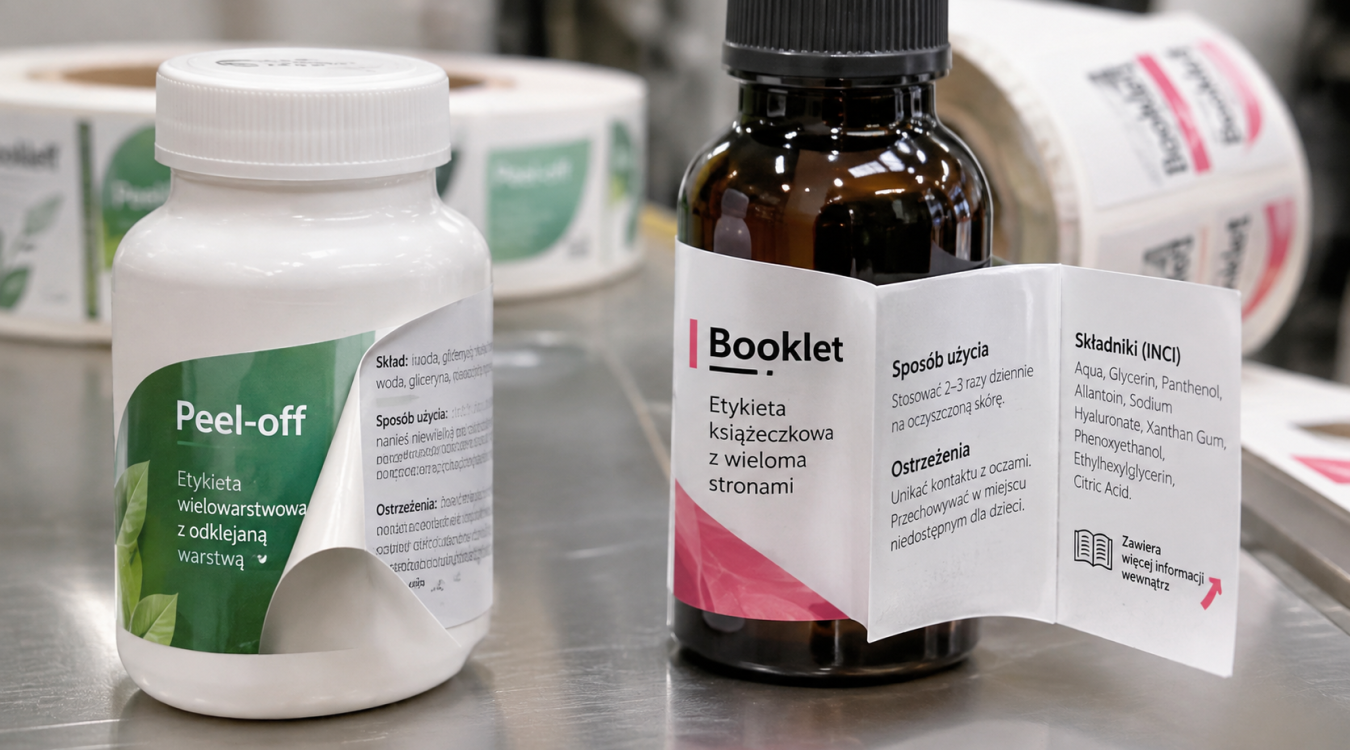
Peel-off and booklet labels are special types of self-adhesive labels that offer additional space for text and graphics. Instead of printing all the information exclusively on the visible front, it can be arranged across successive layers or pages hidden inside the label.
The most important product identification elements, such as the name, brand, and basic markings, remain on the outside. The additional section may contain instructions, a description of how the product works, translations, or supplementary information. Such solutions are also referred to as fold-out, multi-layer, multi-page, or booklet labels. However, these terms do not always refer to the same design.
Peel-off labels – structure and applications
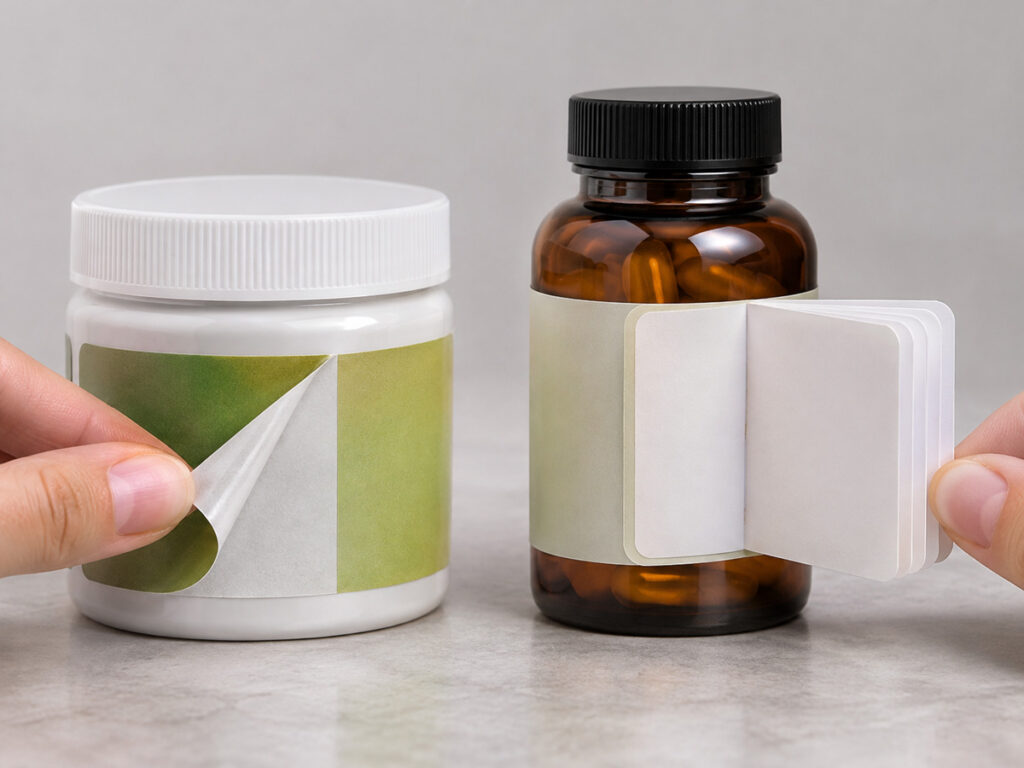
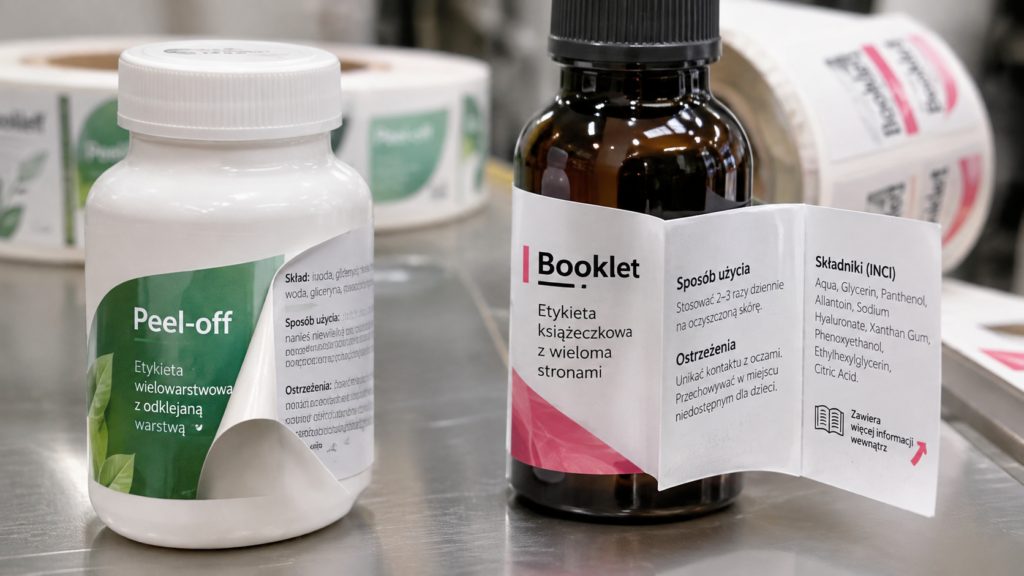
A peel-off label consists of at least two bonded layers, the top layer of which can be peeled back to reveal additional printing. Depending on its design, the label may be resealable. This is achieved using appropriately selected materials and adhesive solutions, and sometimes also a special feature that makes it easier to open.
When closed, the peel-off label resembles a standard product sticker but offers additional space for information. It works well when the packaging is relatively small and the manufacturer needs more space for content but does not require an extensive, multi-page instruction manual.
Examples of uses include instructions for use, descriptions of product variants, additional languages, promotional terms, or details regarding safe use. The number of layers and the method of opening are chosen based on the packaging format and the amount of text.
Booklet labels
Booklet labels combine a self-adhesive label with a small, integrated booklet or fold-out leaflet. Underneath the outer layer are several pages that can be unfolded or flipped through. As a result, a booklet allows you to convey significantly more information than a typical single-layer label—and usually more than a simple peel-off label as well.
This design is worth considering when a product requires extensive instructions, detailed technical specifications, descriptions in multiple languages, or organized content divided into sections. The booklet can remain attached to the packaging, ensuring that the information is available along with the product.
Depending on the design, the label can take the form of a miniature booklet or an accordion-fold. The final number of pages, the method of securing the label, and the ability to reseal it depend on the chosen production method.
Peel-off vs. Booklet – The Key Differences
Both types of labels address a similar problem: they allow you to include more information on a limited area of the packaging. However, the choice should be based on the amount of content and how the recipient will use it.
Criterion | Peel-off label | Booklet label |
Design | Interconnected, fold-out layers | Built-in booklet or fold-out leaflet |
Amount of content | Information spread across several pages | More extensive content across multiple pages |
Typical Applications | Additional descriptions, languages, messages | Instructions, detailed translations, technical data |
Operation | Layer deviation and information retrieval | Opening and Viewing Subsequent Pages |
Complexity | Usually a simpler design | Usually a more complex design |
If you only need additional space for information, a peel-off label is often sufficient. When the content is structured like instructions or spans multiple pages and language versions, a booklet may be a better solution. However, you should not choose a label based solely on the number of pages. The size of the package, its shape, the durability of the seal, and the method of application are also important factors.
Where are multilayer labels used?
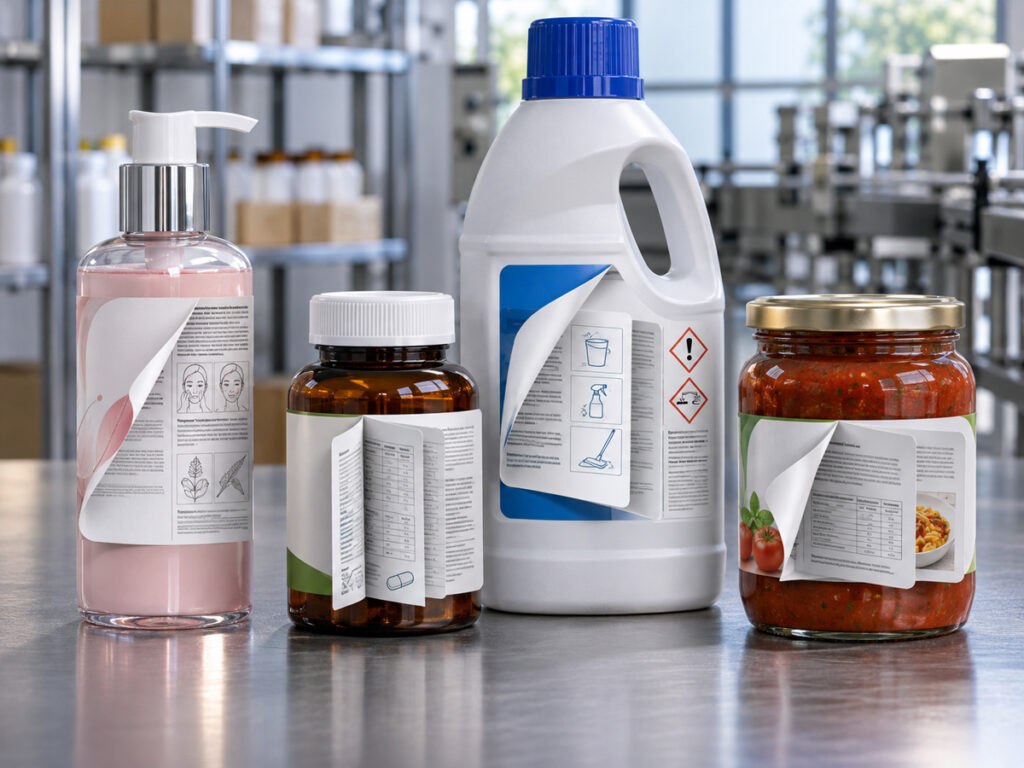
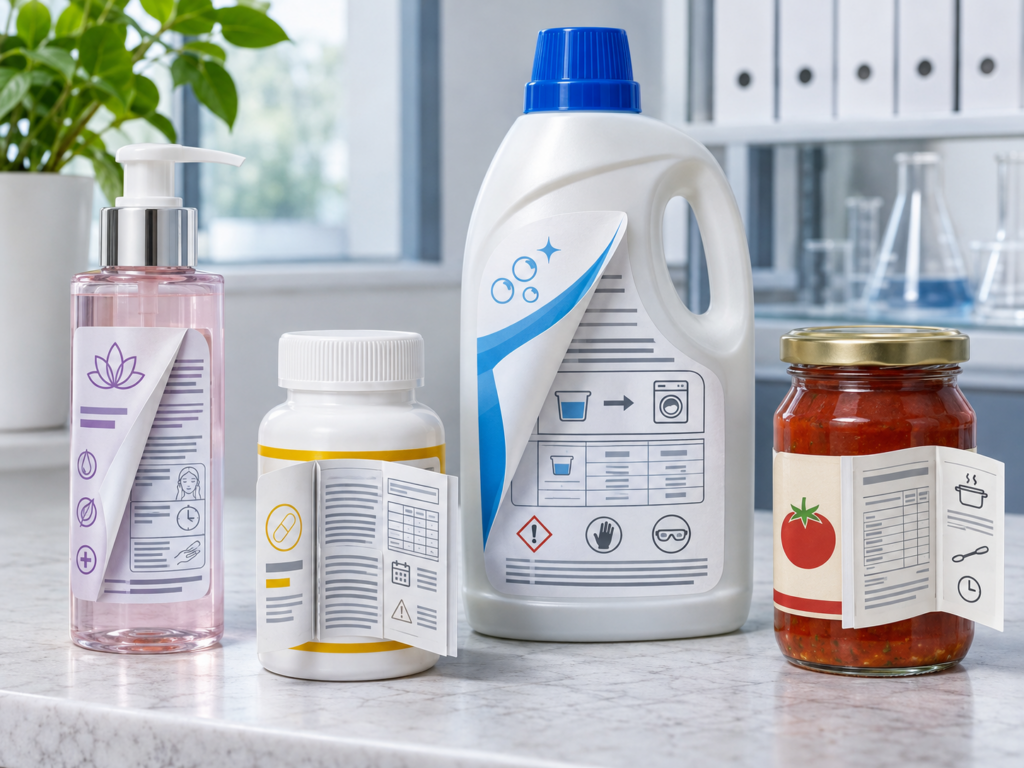
Peel-off self-adhesive labels are particularly useful in industries where aesthetics must be balanced with a large amount of content on small packaging.
- Cosmetics and household chemicals – additional instructions for use, ingredient descriptions, safety precautions, and language versions.
- Industrial chemicals and technical products – operational information, application guidelines, and supplementary notices for users.
- Food products – additional information, translations, and promotional materials, taking into account specific food labeling requirements.
- Pharmaceutical and health-related products – comprehensive product information; however, the possibility of replacing the traditional package insert and the layout of labeling must be verified against applicable requirements.
- Export products – information tailored for multiple markets without the need to significantly enlarge the main label.
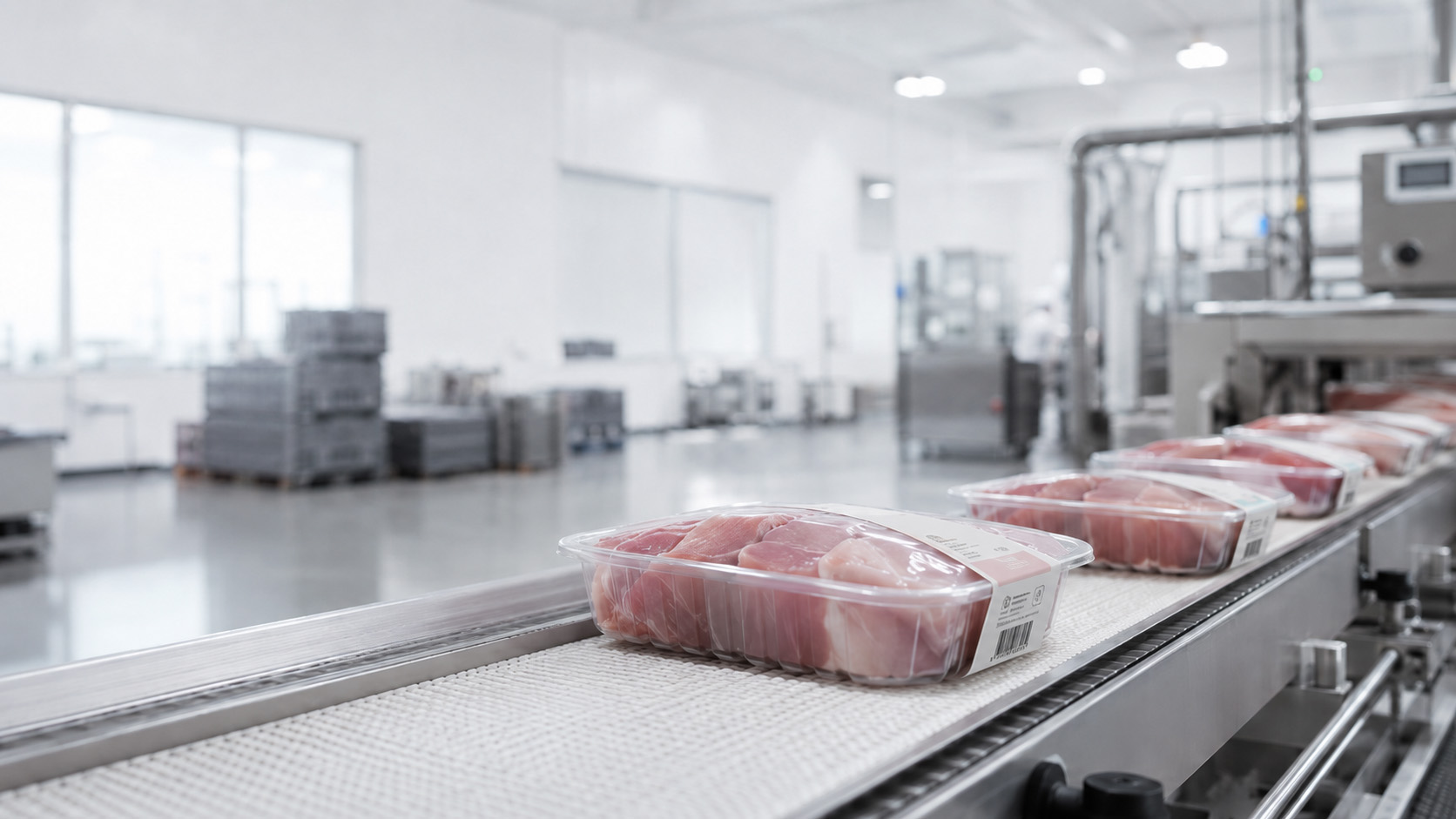
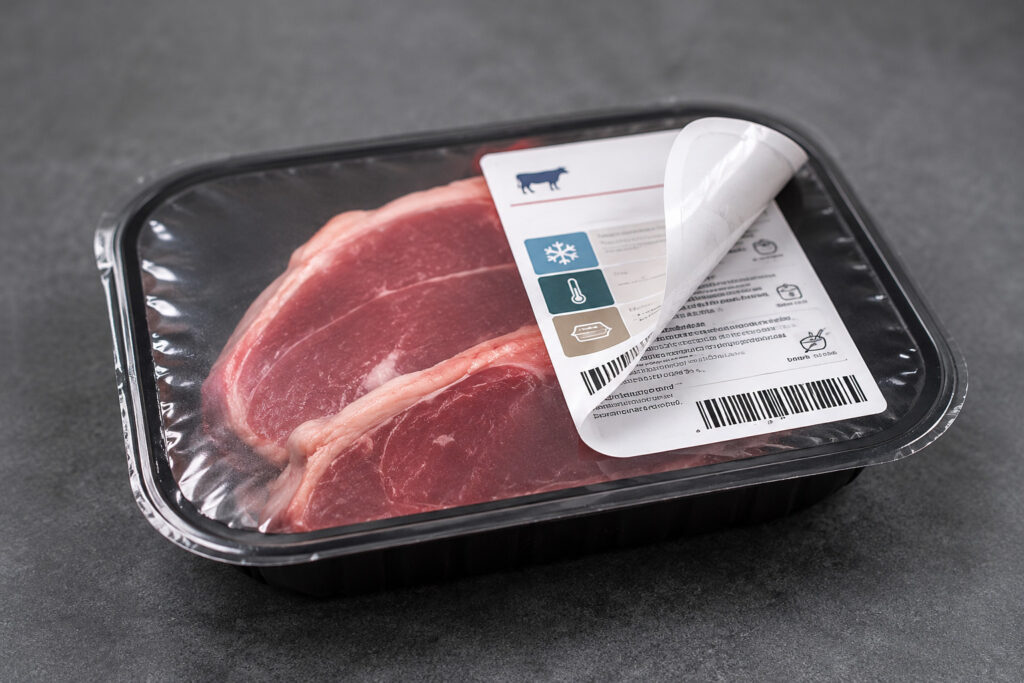
An example of the use of peel-off labels in a specific sector is labels for meat and fish products, which we also describe in terms of packaging and storage conditions.

How do you design a multilayer label?
A good design starts with organizing the content. The front should feature elements that the customer sees right away. Inner layers or pages should be reserved for information that requires further explanation. It’s also important to clearly indicate where to open the label, ensure the text is the appropriate size, and make it easy to reseal the package, if the design allows for it.
The label’s placement on the product is also important. On a heavily curved bottle, a small jar, or a flexible tube, not every multi-layered design will be equally practical. Before ordering the entire print run, it’s a good idea to test a sample on the actual packaging, including checking how it opens and the durability of the adhesive bond.
Note on food labeling: The mere possibility of placing text under a peel-off layer does not mean that all legally required information can be placed there. Mandatory labels must comply with regulations regarding accessibility and legibility. For specific products, the layout of the content must be assessed on a case-by-case basis.
Peel-off labels and booklet labels on a roll – materials and application
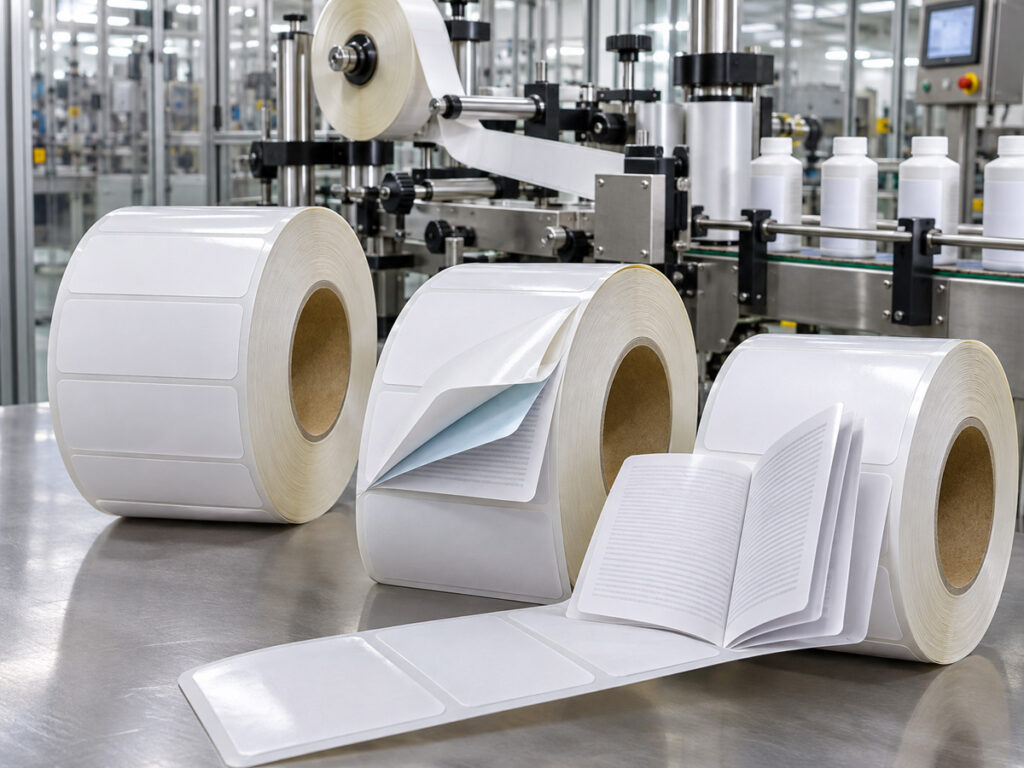
Multilayer labels can be made from appropriately selected paper and film materials, depending on the packaging requirements and conditions of use. Not only is the face material important, but so are the structure of the layer bonding, the type of adhesive, and the label’s resistance to moisture, temperature, and frequent opening.
In industrial applications, the printing of peel-off and booklet labels on a roll may be important. When preparing for application, the format and orientation of the labels, the core diameter, the winding direction, the method of separation from the backing, and the compatibility of the entire structure with the equipment are all important factors. A multilayer label is thicker and more complex than a standard label, so one should not assume that it will function without modification on every labeling line.
HKK helps you take the labeling method into account as early as the order preparation stage. If the product is to be labeled automatically, it’s a good idea to check the label applicator’s requirements at the same time. We also outline general packaging options in our article on delivery formats for self-adhesive labels.

How do I order peel-off labels and booklets?
Complete technical documentation is not required to prepare a quote for custom peel-off labels or booklets. However, it is helpful to provide information that will allow us to select the appropriate design:
- Product type and packaging —e.g., bottle, jar, tube, cardboard box; preferably with a photo and the dimensions of the label space.
- Scope of content – approximate amount of text, number of languages, and whether an additional layer or a multi-page booklet is needed.
- Graphic design – a finished file, the current label, or materials for creating a new version.
- Conditions of use – temperature, humidity, contact with substances, and expected frequency of opening.
- Application method —manually or on an automated line; in the latter case, also the equipment requirements.
- Planned production volume —number of units, number of product variants, and potential repeat orders.
Based on this, you can determine whether a peel-off label or a booklet label would work better, and then select the format, design, and delivery method. HKK Group supplies both types of multilayer labels. If you’re planning to use them on your products, please contact us and submit a request for a quote. We’ll help you clarify your requirements before fulfilling your order.